
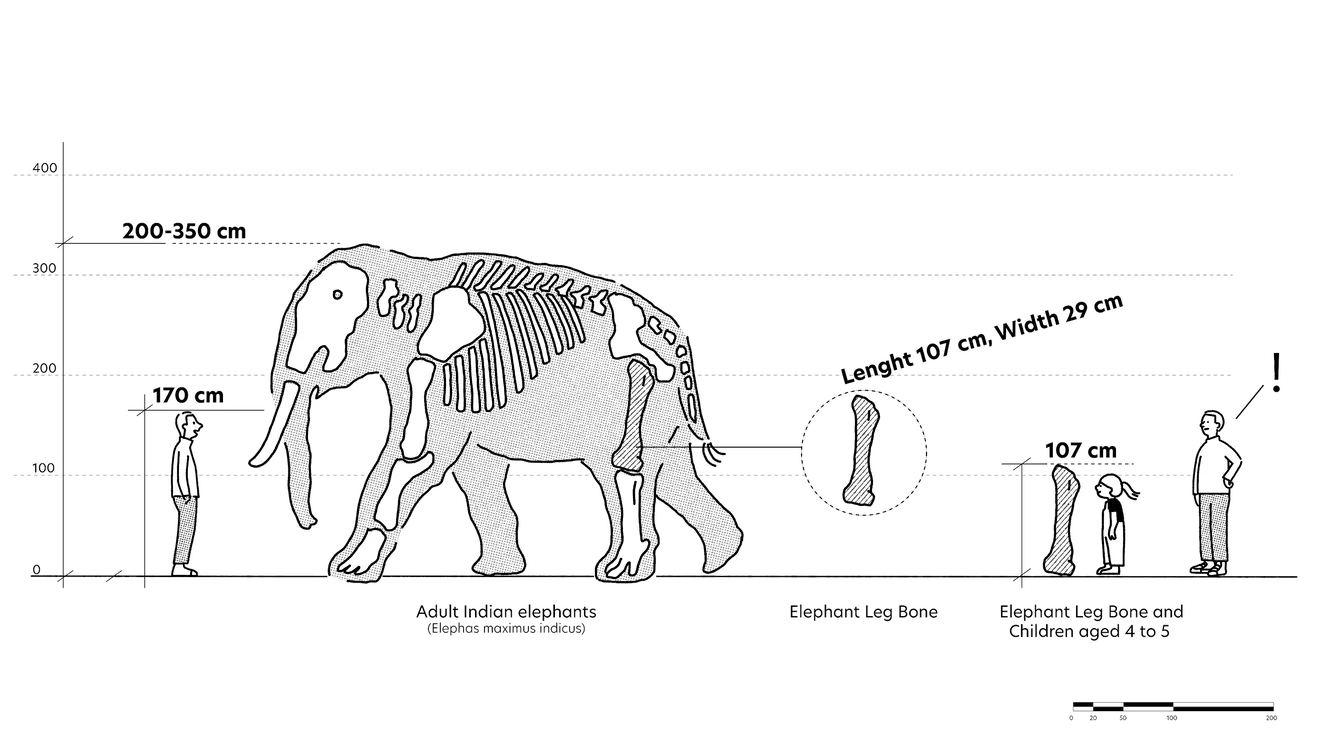
Elephant Leg Bone
Caption:
This femur (thigh bone) belonged to an Asian elephant (Elephas maximus indicus), a subspecies native to the mainland forests of South-East Asia and the Indian subcontinent. It was discovered in a prehistoric site. Such sites also contain ancient fossil remains of related species, such as Stegodon insignis.
Elephants have long played an important role in South-East Asian societies, serving as transport, as war mounts and as draft animals in the logging industry. Elephant bone has also played a role. Possessing specific mechanical qualities, including toughness and high impact resistance, elephant bone was historically used to make various craft objects. These included walking stick handles, betel nut grinders and boxes.
In some cases, elephant bones served as tools. A notable example is the use of elephant thigh bones in the production of pod duang (“bullet money”), the primary silver currency used in Thailand between the fourteenth and twentieth centuries. Mint artisans used the elephant femur as an anvil surface; its unique combination of strength and elasticity allowed it to absorb repeated heavy hammer strikes without deforming or marring the silver coins. Similarly, the reeds of the khaen, a traditional woodwind instrument from northeastern Thailand and Lao PDR, were historically made using elephant bone as a cutting surface.
