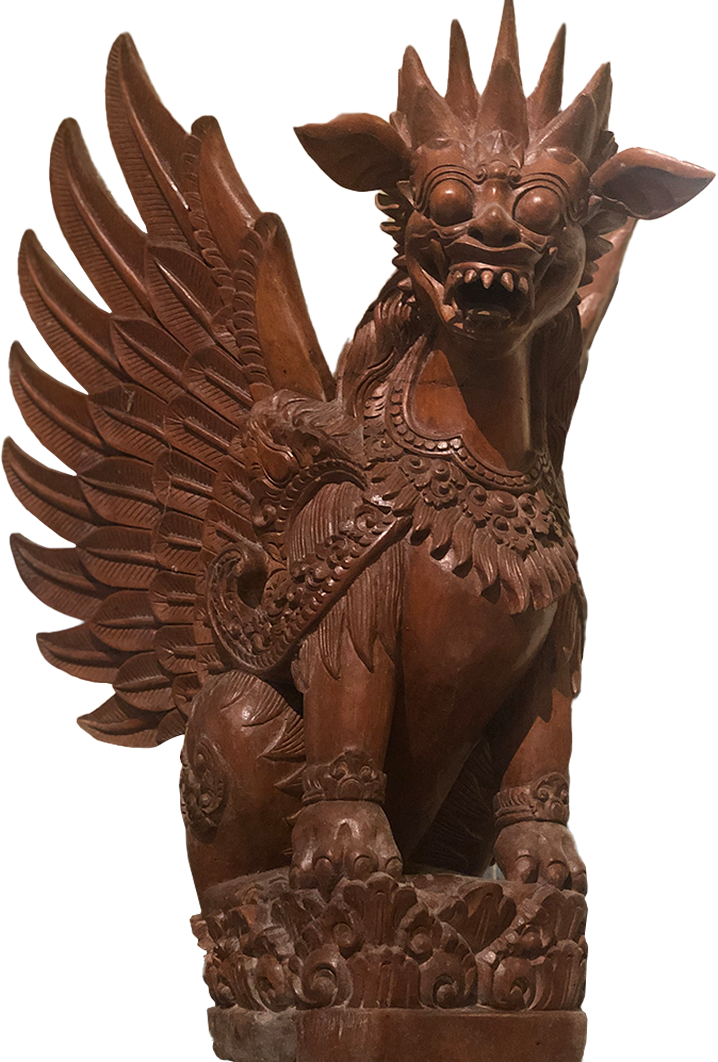
Balinese Singha Bersayap
Caption:
These wooden figures represent the Singa Bersayap (winged lion). Such figures often adorn Balinese temples and palace complexes and were historically placed above entrances and beneath roof structures as guardians, while also serving as sacred mounts for divine images during ritual processions. The fierce expression, open jaws, bulging eyes and extended wings communicate its role as a supernatural guardian against evil forces. The wings, recalling the Garuda, transform the lion from an earthly creature into a celestial being.
In sacred architecture, singa figures such as these reinforced the understanding of the temple as a protected cosmic space, with the temple itself a symbolic reflection of Mount Meru, the sacred mountain at the centre of the universe in Hindu-Buddhist cosmology. Through these guardian figures, architectural spaces were connected to the divine order they represented.
While the lion is not native to Southeast Asia, it has a powerful presence in the region’s religious and artistic traditions. Imported into the region via Hindu-Buddhist traditions, the lion came to represent sovereignty, protection and sacred power in the region. In Bali, this animal developed into the mythical form of the singa, a guardian figure that stands on the threshold between the human and spirit worlds.
Another expression of the Balinese singa is the Barong Ket, the lion-like protector who battles the witch Rangda in ritual performances. Their eternal struggle represents the tension between opposing forces: chaos and order, destruction and protection. Rather than eliminating darkness, the performance renews the balance that allows the world to continue, reaffirming the Balinese belief that harmony depends on maintaining equilibrium between these forces.
The lion was adapted into local traditions across Southeast Asia. In Myanmar, the lion became the chinthe, a guardian figure placed at the entrances of pagodas and important buildings. One legend tells of Sīhabāhu, the son of a lion and a human princess, who killed a lion only to find out that it was his father. To honour his father and atone for the killing, he commissioned lion images for pagodas, giving the chinthe its associations with royal authority, protection and Buddhist devotion.
In the Malay world, the lion entered local memory through the founding legend of Singapore, in which the Sumatran prince Sri Tri Buana (Sang Nila Utama) encountered a powerful animal at Temasek believed to be a lion and named the settlement Singapura, from the Sanskrit singa (lion) and pura (city).
The Balinese singa, Malay singa and Burmese chinthe demonstrate how an animal absent from Southeast Asia’s natural landscape became deeply embedded in the region’s cultural consciousness. Through shared religious traditions that were reshaped via local myths, rituals and political histories, the lion became a guardian figure across Southeast Asia with particular meanings within each community.