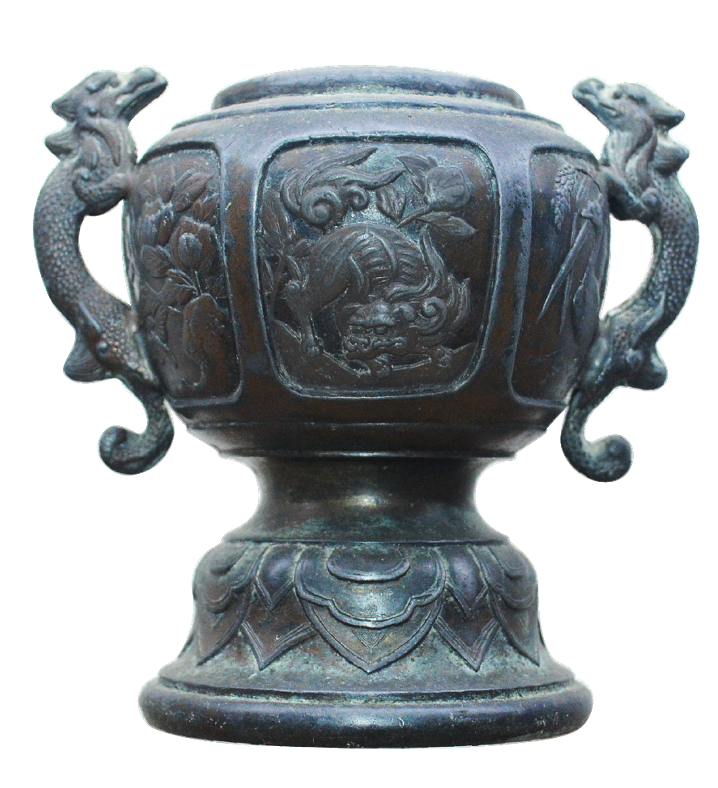
Holy water vessel
Caption:
Within Theravada Buddhist practice, urns such as this vessel are used to hold Nam Phra Phutthamon (holy water), which is consecrated through monastic chanting and protective blessings. This sanctified water is sprinkled during ceremonies such as longevity rites, the consecration of new buildings and housewarmings. The act of sprinkling holy water serves as a physical channel to convey blessings, spiritual safety and peace to the participants.
The vessel’s most prominent features are its dragon handles, cast on opposite sides of the body with their heads turned inwards towards the rim. In Chinese tradition, dragons (long) were associated with imperial authority, prosperity and control over water and rainfall. These auspicious associations resonated strongly in Southeast Asia, where Naga – powerful serpent-like beings of Hindu-Buddhist traditions – similarly guarded rivers, lakes and sources of fertility. In the water-dependent societies of the Songkhla Lake basin, dragons and Naga shared a common symbolic role: as protectors of the waters that sustained human life. The presence of dragons on the holy water vessel indicated protection for the sacred waters it contained, connecting human communities with spiritual forces.
The vessel’s other decorative elements reinforce this connection between spiritual protection and worldly well-being. Its base is in the form of overlapping lotus petals, a Buddhist symbol of purity and enlightenment. Six low-relief panels around the vessel’s body depict auspicious imagery, including birds among blossoms, guardian lions, ducks among rice stalks, cranes beside bamboo, deer near plum blossoms and egrets among aquatic plants. Together, these motifs express aspirations for longevity, prosperity, agricultural abundance and harmony between humans and the natural world.
The vessel’s hybrid style reflects the cosmopolitan character of the place it was forged, the Songkhla Lake basin, where Chinese migrant communities, local Thai populations and Buddhist institutions interacted over centuries through maritime trade networks. From the late Ayutthaya to early Rattanakosin periods, Chinese artisans and merchants contributed metalworking skills and decorative traditions that were incorporated into local religious objects. Wealthy merchants and community leaders often commissioned elaborate ritual vessels as temple offerings – acts of communal devotion.
Produced in a region shaped by centuries of trade and migration, the vessel combines Chinese decorative traditions with Theravada-Buddhist ritual function, demonstrating how communities around the Southern Thai Peninsula adapted artistic and spiritual traditions into local forms. Whether expressed as the Chinese dragon or the Naga of Buddhist and Hindu traditions, these creatures embodied the protection and renewal of the life-giving waters upon which communities depended.