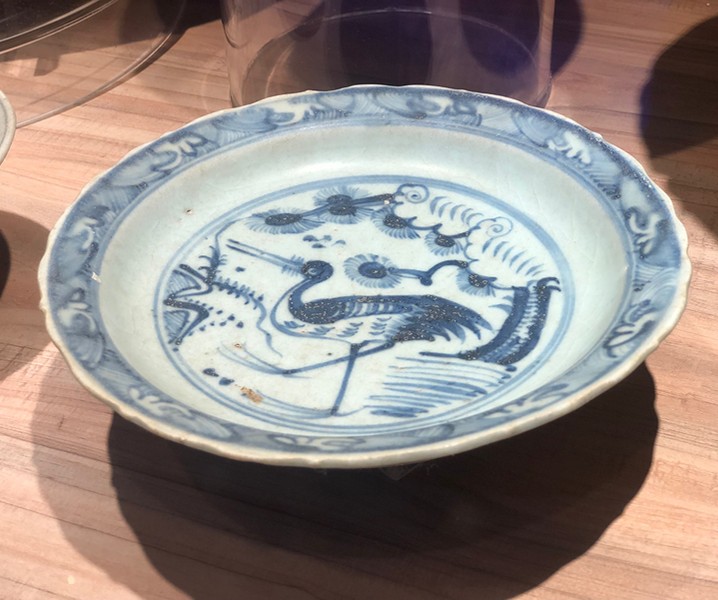
Blue and white dish with flattened foliate rim
Caption:
This dish depicts a crane standing in a body of water surrounded by plants, and it features a decorative border around the rim. It was recovered from a shipwreck, discovered in 1997, that was 32 nautical miles off the coast of Brunei at a depth of 62 metres. The excavation uncovered more than 13,000 artefacts, the majority of which were ceramics dated to the late fifteenth century and the early sixteenth century CE.
Produced in the kilns of Jingdezhen in Jiangxi Province, China, this blue and white ware is characteristic of the Ming dynasty, a period regarded as a golden age for Chinese ceramics. At this time, a shift from stoneware to porcelain established the cobalt blue underglaze style as the most recognizable form of Chinese export ware. The kilns at Jingdezhen supplied both imperial wares and the vast international markets that carried Chinese ceramics across maritime Southeast Asia and beyond.
The crane on this dish carried its meaning with it. In Chinese culture, the crane represents longevity and good fortune, associations that made it a natural choice for objects intended to impress, as gifts and to circulate as markers of prestige. Recovered from the hold of a ship that never reached its destination, this dish demonstrates one way the crane motif moved through the maritime trade network that connected China to the ports of Southeast Asia.