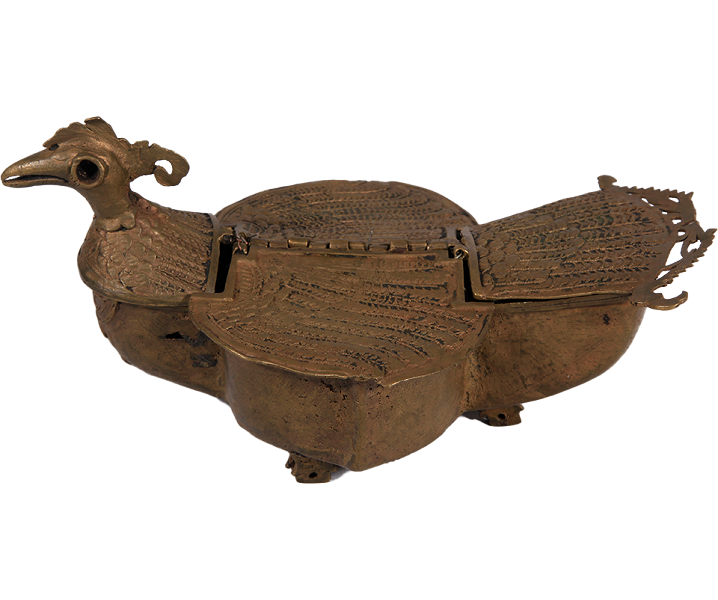
Calapa with bird motif
Caption:
This container, a calapa, serves to store betel leaves, areca nuts (pinang) and tobacco (sigup), and it was historically used when guests came to visit and during gatherings such as weddings and thanksgiving ceremonies. In the form of a bird, featuring large wings and a spread tail, the calapa is an object whose form invites interpretation.
The design may have been inspired by the Rhinoceros Hornbill, a species native to Borneo and once common in Brunei Darussalam. The long, curved beak on this container and the prominent structure rising above the bird’s head closely resemble those of the hornbill, suggesting that the artisan may have drawn inspiration from the most familiar and culturally significant bird of the local landscape. At the same time, the design of the calapa also resembles the peacock, a bird whose elaborate plumage and regal bearing have inspired art across much of Southeast Asia. Peacocks are not native to Brunei Darussalam, however, so the resemblance here likely speaks to the influence of artistic traditions carried along the trade networks that long connected Brunei to the wider region.
Whether a peacock, hornbill or an imaginative synthesis of both, the bird form chosen for this vessel of hospitality speaks to the way Southeast Asian decorative traditions have long drawn on the natural world. The vessel also reflects the movement of ideas across the Southeast Asian region. In the context of Brunei traditions, a container associated with generosity and ceremony is a fitting vehicle for the image of the hornbill as the bird’s associations with protection and vitality run deep across the communities of Borneo.