Cowrie shells
Caption:
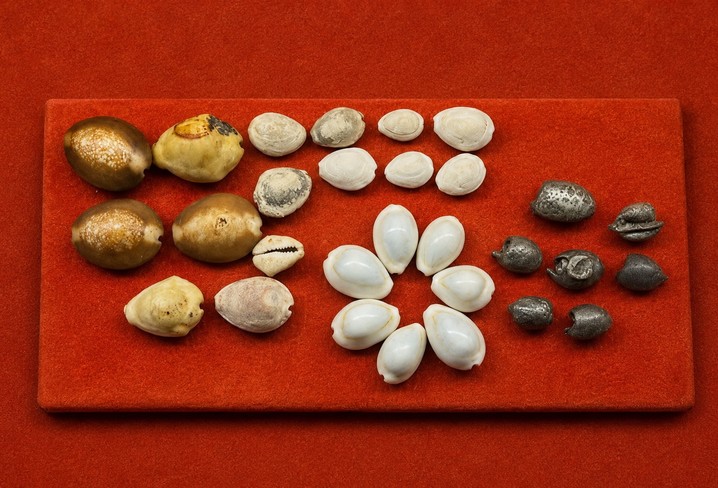
Cowrie shells are the exoskeletons of small marine gastropods belonging to the family Cypraeidae. They are characterised by their smooth, glossy texture, oval seed-like profiles and varying natural hues, ranging from porcelain white and cream to pale yellow and deep brown.
Historically, cowrie shells (bia) served as a highly efficient medium of exchange. Across markets in Southeast Asia, including the southern Thai Peninsula, varieties such as bia chan, bia nang and bia mu were valued for their consistent size, durability and the difficulty of imitating them. Whenever natural cowrie stocks became scarce, local authorities or merchant guilds produced bia loha – small cast metal replicas shaped specifically to mimic cowrie shells – marking the transition from natural currency to human-made token coinage. This image displays cowrie shells alongside their metal replicas.
Cowries were once used in everyday transactions, from purchasing food and household goods to trading regional commodities and paying taxes. These shells were also used as convenient tokens and betting chips in traditional gambling games such as ka thua. Even during the reigns of King Rama IV and King Rama V, when modern minted coinage was introduced by the central government and widely used, cowries remained a crucial currency for local trade within rural coastal communities. The role of cowrie shells in economic life is recorded in sources including the Law of the Three Seals (Kotmai Tra Sam Duang), royal administrative records and regional literature. The legacy of cowries remains embedded in the Thai language – the word bia continues to serve as the root term for financial concepts, from bia liang (an allowance or stipend) to bia wat (a military pension).
The importance of cowries was closely tied to the environments that produced them. The bia sat (washed-up cowrie) legend from Pak Phanang District recounts historical periods when massive ocean swells deposited vast quantities of cowries onto the shoreline, allowing coastal villagers to gather them freely for use as currency. The story reflects the close relationship between coastal communities and the sea, while also explaining the economic importance of the Pak Phanang estuary.
Beyond their role as a currency of exchange, cowries had social and spiritual meanings. They were associated with good fortune, wealth and fertility, which led them to be incorporated into rituals and protective objects. In southern Thai and Sino-Thai traditions, amulets made from cowrie shells, bia kae, were believed to protect against malevolent spirits, black magic and misfortune, while cowrie shells buried beneath house foundations or sacred structures symbolized enduring prosperity. Ceremonial cowrie strands (phuang hoi bia) were used in votive offerings, the fulfillment of spiritual vows and communal prayers for agricultural and maritime abundance.