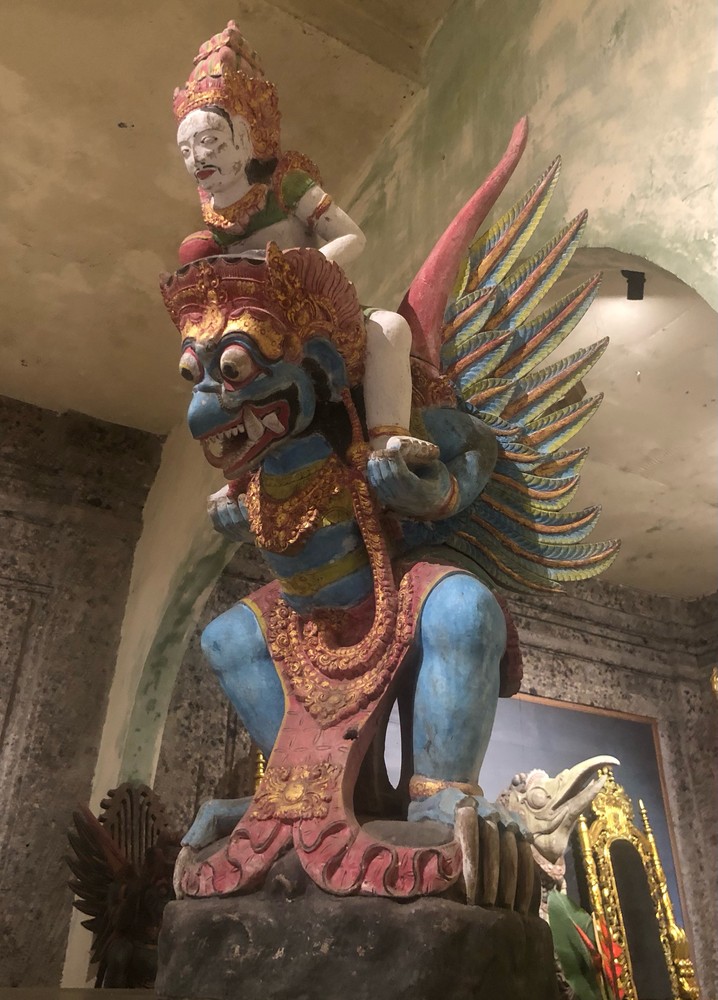
Garuda sculpture
Caption:
This wooden sculpture depicts Vishnu seated upon his mount, Garuda. Both figures are adorned with crowns and jewellery that signify divine and royal authority.
Garuda, a hybrid being with the body of a human and the features of a bird, is one of Southeast Asia’s most enduring legendary figures. In Hindu mythology, Garuda embodies strength, knowledge, courage, loyalty and discipline, while his role as the vehicle of the Hindu god Vishnu — the preserver of the universe — connects him with the protection of cosmic order.
In Bali and the wider Java region, rulers were often associated with Vishnu and his incarnations, linking kingship with the deity’s role in maintaining harmony and order.
One of the most famous accounts of Garuda appears in the Indian epic Ramayana. During Rama’s battle against the demon king Ravana, the latter’s son Indrajit uses the magical serpent weapon known as the nagapasha to bind Rama and his brother Lakshmana, leaving them powerless. Suddenly, a great storm descends upon the battlefield and from the sky emerges Garuda, whose very presence terrifies the serpents that form the weapon’s bindings. As Garuda approaches, the serpent arrows release their hold. Garuda then restores Rama and Lakshmana’s strength by touching their wounds.
Although this story belongs to a world of divine beings and mythical creatures, it reflects close observations of the natural world. The ancient association between Garuda and serpents echoes the real relationship between large birds of prey and snakes, and how communities saw birds as protectors against creatures sometimes associated with danger. As Hindu epics travelled to Southeast Asia, where such natural dynamics apply too, this tale was preserved, including in local versions of the Ramayana such as the Thai Ramakien, in which Garuda represented attributes such as protection, power and victory over harmful forces.
Garuda figures are a common feature of Hindu-Buddhist sacred spaces, including as architectural elements, ritual objects and standalone sculptures. Their presence reflects the Hindu-Buddhist cosmology in which temples represent a connection between the earthly and divine realms, while sacred beings such as Garuda serve as protectors of that boundary. The sculpture therefore represents not only a religious image, but also the process through which Southeast Asian communities transformed shared mythological traditions into expressions of their own identities, beliefs and histories.