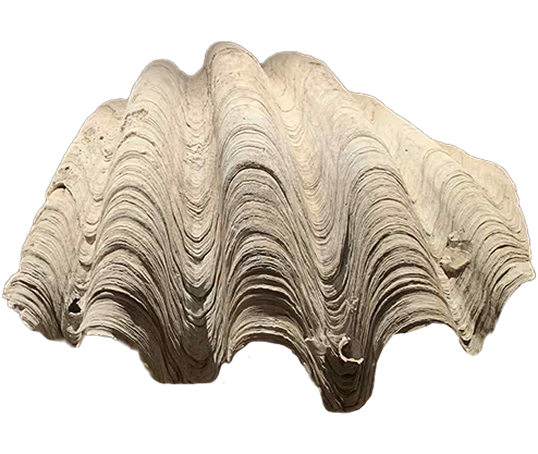
Giant Clams
Caption:
The giant clam is a magnificent marine bivalve whose history is deeply intertwined with both the delicate marine ecosystems of Southeast Asia and the region’s rich cultural beliefs and practices. Southeast Asia is home to many of the world’s twelve giant clam species, which live in the shallow, clear waters of intertidal zones and coral reefs. While sometimes portrayed as ‘killer clams’, they are in fact harmless creatures.
Several species occur in Thai waters, including the iconic fluted giant clam, easily recognized by the prominent, protruding scales on its shell known as scutes. Nestled within the shell is a fleshy, vibrant mantle that displays rich hues of purple, green and yellow. These striking colours are produced by symbiotic algae called zooxanthellae that live inside the tissue and provide the clam with essential nutrients through photosynthesis. Giant clams also obtain nutrients via filter feeding. Their removal of excess nutrients from the water in this way makes them an essential part of keeping marine ecosystems healthy.
Shell forms have long been part of the intangible and material cultures of the Southeast Asian region. Spiral motifs that echo those of sea snail shells appeared on pottery as early as 300 BCE. Giant clams hold particular cultural significance in the region as a consequence of a relationship with human communities that stretches back millennia.
In Thailand, archaeological digs at the Bronze Age site of Ban Nam Daeng in Kanchanaburi Province unearthed prehistoric tools and giant clam shell bracelets dating back some 3,500 to 4,000 years. The presence of these shell objects in areas far beyond the coast is evidence of early trade networks and suggests that these durable marine materials circulated as markers of exchange and social status. In Singapore, archaeological evidence underscores this long-standing presence, with tridacnid shells excavated near St Andrew’s Cathedral dating back to the fourteenth century.
Today, giant clams face enormous pressures that threaten their survival. Their shallow reef habitats make them highly vulnerable to habitat degradation, including through coastal development, land reclamation, pollution and climate change. They are also overharvested, particularly for the international marine aquarium trade. Because giant clams are slow-growing and remain permanently anchored to fixed locations, they are particularly vulnerable marine species, and their recovery from drastic population declines is exceptionally difficult.
Globally, giant clams are strictly protected under CITES regulations, and the true giant clam (Tridacna gigas) is listed as Critically Endangered on the IUCN Red List. Although international laws prohibit the illegal collection and trade of giant clams, overharvesting continues in parts of the region, leading to the disappearance of some species from certain areas. This is the case in Singapore. Once abundant in Singapore’s coastal waters, several clam species have been driven to local extinction, and the fluted giant clam is listed as Critically Endangered in the Singapore Red Data Book.
Safeguarding reef habitats and water quality remains absolutely essential for the survival of giant clams. In a determined effort to save and propagate these vital creatures, Thailand has pioneered special conservation programmes, breeding and raising all of its native giant clam species as part of a long-term effort to repopulate the region's reefs.