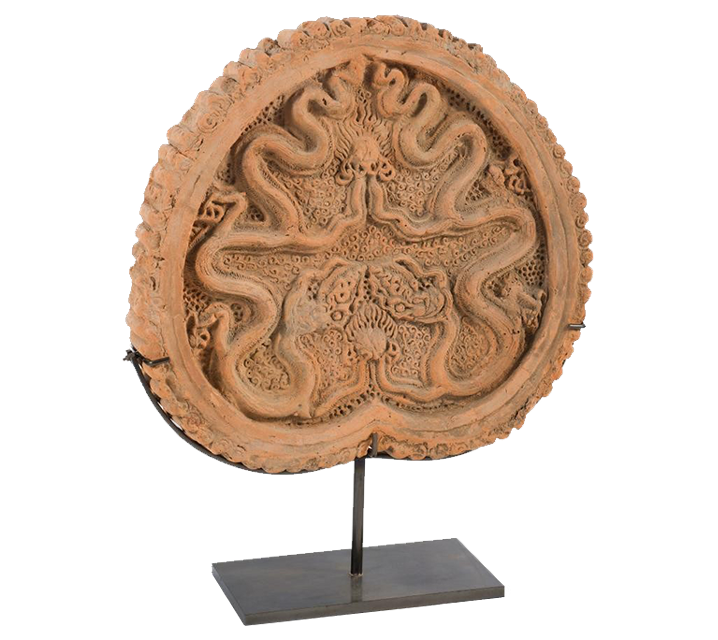
Large tile with dragons
Caption:
This large earthenware tile from the Ly dynasty (1009–1225) reflects the powerful role of the dragon in Vietnamese traditions. The tile portrays sinuous dragons in vigorous movement amidst scrolling clouds – imagery typical of Ly dynasty art. During the Ly dynasty, the dragons adorned temples and palaces frequented by the king. Similar elements in this style have been found at the ancient royal capital in Hanoi, formerly known as Thang Long (rising dragon).
Dragons have long had important symbolic and ritual meaning in Viet Nam and elsewhere in Southeast Asia. According to Vietnamese origin stories, the Vietnamese people are descended from the union of Lạc Long Quân, the Dragon Lord of Lạc, and Âu Cơ, the Mountain Fairy. Their children inherited both the qualities of the sea and the mountains, reflecting a worldview in which dragons connected different realms of nature. As beings associated with rivers, clouds and subterranean waterways, dragons were believed to shape the landscape itself, with their presence sustaining the flow of life-giving energy (khí) through the earth.
This connection between dragons and the land is also reflected in the legend of Hạ Long Bay (the bay of the descending dragon). According to this legend, when a young Vietnamese nation faced invasion from the sea, a mother dragon and her offspring descended to protect the people. They cast jewels that became islands and barriers that defended the coast. This story presents the dragon not only as a creature of power, but as a guardian whose presence protects both the people and the territory they inhabit.
The dragon’s prominence in Ly dynasty architecture reflects a wider Southeast Asian pattern in which mythical beings were closely tied to stories of origins, protection and the order of the world. Across the region, dragon and serpent traditions once connected communities to the landscapes around them, reflecting the belief that human societies were sustained through relationships with powerful forces of nature.