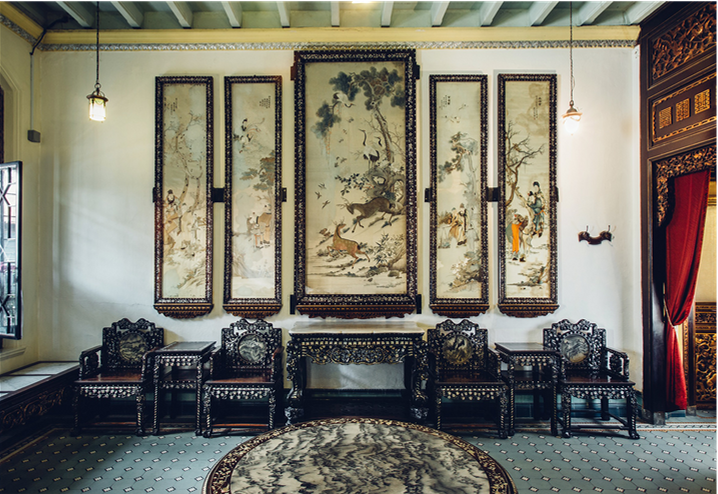
Mother-of-pearl furniture
Caption:
This table and set of chairs were made in Guangdong Province from dark wood inlaid with handcrafted mother-of-pearl. Designed for Peranakan Chinese (Baba & Nyonya) whose commercial networks extended across maritime Southeast Asia, this set is an example of luxury furniture.
The material that gives this furniture its character is the mother-of-pearl, cut from the iridescent inner lining of marine mollusc shells. The shimmering mother-of-pearl forms motifs of flowers, birds and mythical creatures, blending Chinese artistic symbolism with local influences. The technique shares a common foundation with traditions such as Thai khruang pradab muk – in which shells are gathered, cut, shaped and set against a dark surface to create intricate, contrasting patterns.
The Peranakan Chinese, a culturally hybrid community shaped by interactions between Chinese and Malay worlds, developed domestic styles that reflected their cosmopolitan identities. Wealthy households combined Chinese decorative motifs with Western furniture forms, creating interiors that expressed both ancestral connections and participation in global trade networks.
Exported Cantonese furniture from the late Qing and early Republican periods reflected its own processes of adaptation, incorporating Western Rococo forms and carving techniques while retaining traditional Chinese woodworking practices.
In Peranakan households across Malacca, Singapore, Penang and the wider region, furniture like this marked wealth accumulated through trade. The mother-of-pearl embedded in its surface – the shell of a marine creature, worked by artisans in southern China – was brought to Southeast Asia via the same maritime networks through which the Peranakan communities themselves had moved. They then settled and built the material world of their homes using both imported and local materials.
In the region, furniture such as this became a visible expression of wealth and social position. The mother-of-pearl that illuminates its surface embodies the same process that defined Peranakan material culture: the adaptation of elements from across the maritime world into a distinct regional identity.