Kolek
Caption:
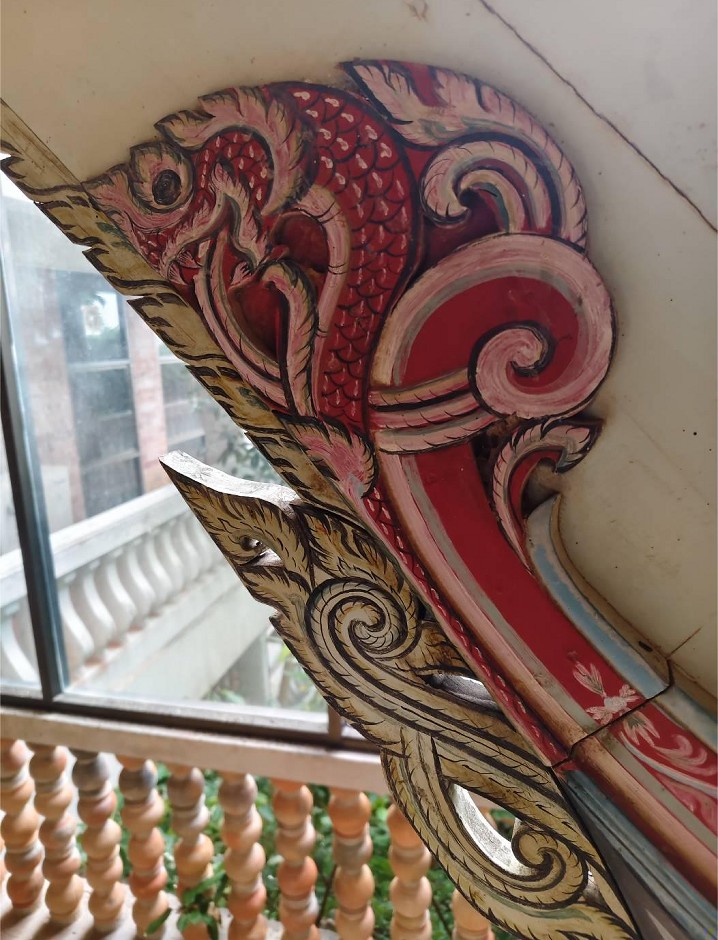
A kolek is a traditional fishing vessel of the lower south of Thailand. Known as a buatan barat across the border in northern Malaysia, its hulls are carved and painted with motifs of the Naga, Hanuman and Burong Singo (lion-bird) amidst waves and floral vines that draw together Thai, Malay and Javanese traditions. The kolek's builders work without lofting or drafting techniques; the design emerges instead from the builder's imagination and experience, shaped by the owner's requirements for size and the materials provided. Each boat is, in this sense, a unique object.
The Naga, featured on this boat, represents authority, abundance and protection from the sea. Depicted in bright colours, its presence is intended to project bravery and fierceness – qualities a vessel and its crew would need on open water. These designs are therefore not just artistic; they are spiritual anchors for fishermen, reflecting a worldview that sees the ocean as both a source of life and a sacred space.
The kolek and its imagery belong to a region whose cultural connections long preceded the borders that now divide it. As far back as the second century CE, ancient settlements here linked the markets of India and China across a shared trans-Peninsular route. Though the arrival of Islam and Theravada Buddhism drew this area into two distinct cultural orbits, they continued to share natural resources, agricultural and trading life and a common material culture. The region was also situated between two overlapping centres of power (mandala) – the Thai mandala radiating from the Chao Phraya delta and the Malay mandala of the Melaka and Johor empires.
The kolek, still in use among fishing communities in Kelantan and Pattani today, represents these layered relationships: a vessel whose painted Naga speaks not to one tradition but to the intertwined cosmologies of a shared sea.