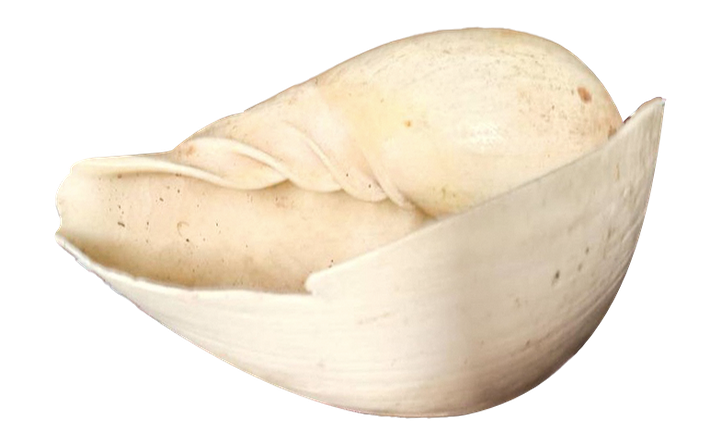
Sacred conch shell
Caption:
The conch shell (Turbinella pyrum), known in Thai as hoi sang and in Sanskrit as shankha, has an elegant teardrop silhouette, a thick, highly calcified exterior and a smooth, hollow interior whorl. This geometry made it useful in human societies as a means of holding water and also as a horn, while the spiral gave it cosmological meanings and made it a vessel of religious significance in Southeast Asia for millennia.
In Brahmanical-Hindu cosmology, the conch shell is a foundational symbol for Vishnu, the protector of the universe. He holds the conch shell in one of his four hands, along with the discus, the mace and the lotus. The conch represents the primordial sound of creation. Vedic mythology records that Vishnu descended into the abyssal depths to retrieve sacred texts from a demon concealed inside a conch, thereby infusing the shell with absolute spiritual purity. As such, any water passing through its chamber is transformed into a holy purifying medium.
Among conches, the highest status belongs to the rare mutation known as the right-turning shell. Revered as an exceptional natural form associated with cosmic blessing, such specimens were traditionally reserved for important state and religious ceremonies, including royal coronations.
Along the Maritime Silk Road, conch shells circulated as premium commodities and high-status diplomatic tributes presented to kings. As these associations with conch shells entered Southeast Asia, through centuries of trade and migration, they were reinterpreted. The broader cosmology merged with indigenous beliefs to make the conch the primary vessel for consecrated water (nam mon) across major life-transition ceremonies, including monastic lustration, housewarmings and wedding rituals.
In the folk traditions of southern Thailand, for example, the conch is closely associated with rituals centred on sacred hydrology, where water is regarded as an element of cosmic purity and the source of biological life. To enhance this auspicious quality, many southern Thai households introduce sacred sweet-scented bael leaves (bai matoom) into the conch’s reservoir during domestic lustration ceremonies. The practice of Sang Rot Nam, pouring sacred water from the mouth of a conch shell onto the hands of a bride and groom, remains a foundational matrimonial rite in contemporary Thailand.
As an object originating from the sea, a realm associated with abundance and wealth, the conch serves as a symbol of good fortune and material prosperity, particularly among coastal merchants, shopkeepers and fishermen. Merchants commonly place sacred conches on storefront altars or sales counters to bless daily transactions. Sometimes they place coins, gold leaf or miniature talismans inside the shell’s aperture to enhance its auspicious power.
Today, the conch shell stands as a vital material archive documenting the synthesis of deep Vedic cosmology, local folk traditions and maritime commerce across Southeast Asia.