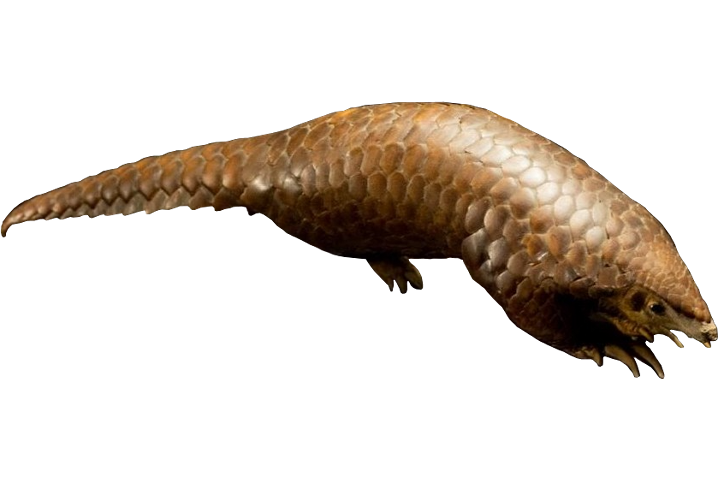
Sunda Pangolin
Caption:
The Sunda pangolin (Manis javanica) is a shy, nocturnal mammal native to the tropical forests of Southeast Asia. Enclosed in overlapping keratin scales, it resembles a living suit of armor and curls into an impenetrable ball when threatened. Preserved specimens at the Lee Kong Chian Natural History Museum—mostly salvaged from accidental roadkill—offer visitors a rare, up-close look at this creature's unique anatomy. To combat local threats, the Singapore Pangolin Working Group was established in 2014, uniting government agencies, researchers, and community organizations to coordinate rescue efforts, habitat conservation, and public education.
Beyond modern ecology, the pangolin holds a fascinating place in traditional folklore due to its resemblance to mythical creatures—most notably the dragon. In classical East Asian texts, such as Li Shizhen’s Bencao Gangmu, the pangolin was referred to as lingli (“scaly carp”) and colloquially dubbed the “Earth Dragon” (Di Long). Because traditional dragons were portrayed as composite beasts covered in carp scales with power over subterranean realms, the pangolin—the world's only scale-covered mammal—was viewed as a living, terrestrial relative of the mythical beast. Its powerful claws and burrowing habits gave rise to legends that it navigated through a vast network of underground tunnels, cementing its image as a creature of protection, quiet resilience, and subterranean mastery.
Today, the Sunda pangolin is critically endangered. Driven by illegal wildlife trafficking for its meat and scales—falsely valued in traditional medicine—alongside rapid habitat fragmentation, wild populations face severe decline. High-profile transit seizures in Singapore highlight the global scale of wildlife crime, while climate change threatens the ant and termite populations vital to the pangolin's survival.
Bridging past and present, natural history and cultural heritage, the Sunda pangolin shows that animals in material culture are not just decorative motifs but storytellers carrying meaning across time. Through this remarkable creature, we can reflect on how cultural heritage can inspire conservation and care for endangered species. Protecting pangolins safeguards not only their lives but also the stories, creativity, and traditions they represent, preserving both natural and cultural heritage for future generations.