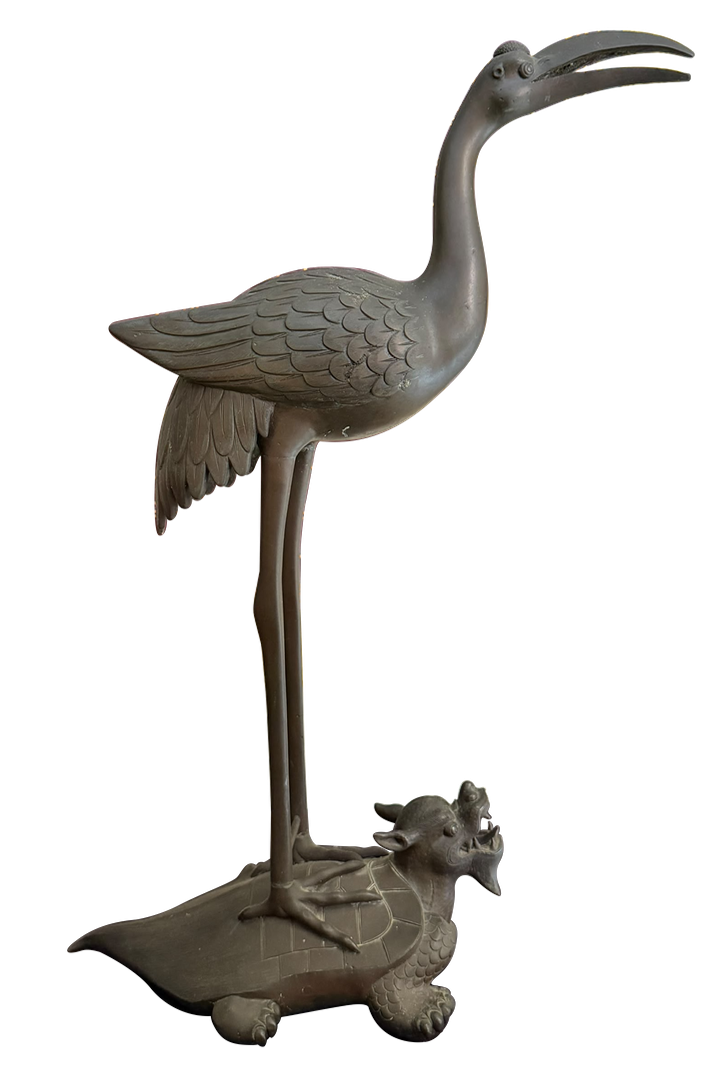
Dragon-head tortoise and crane ornaments
Caption:
This set of three brass statues features a large crane standing atop a tortoise, which has a dragon's head and dragon-like paws, flanked by two smaller cranes perched on tortoises that have ordinary heads. The smaller pieces serve as candle holders. Together, the three statues form a composition that was likely designed to be displayed at an entryway, as their size made a desk arrangement impractical.
Across Chinese, Japanese and Korean traditions, the tortoise represents endurance, stability and protection, while the crane signifies peace, harmony and purity. In these traditions, the tortoise and crane are paired as symbols of longevity, based on the knowledge that both creatures possessed extraordinarily long lifespans. Together, they express the wish for a long and prosperous life. Within Baba & Nyonya households, the pairing of cranes and tortoises appeared widely on embroidered textiles, porcelain, jewellery, furniture and other objects.
Crafted in brass, these statues were intended to endure. The dragon-headed tortoise adds another layer of auspicious meaning. The dragon and tortoise are two of the four celestial animals in Chinese cosmology, associated respectively with power and stability. Their pairing combines multiple forms of protection and good fortune.
In this set, animals drawn from land, water and the mythical realm were brought together to create an auspicious guardian at the threshold of the household, as a talisman for long life and stability. This set reflects how Peranakan communities adapted Chinese symbolic traditions within the material culture of maritime Southeast Asia.