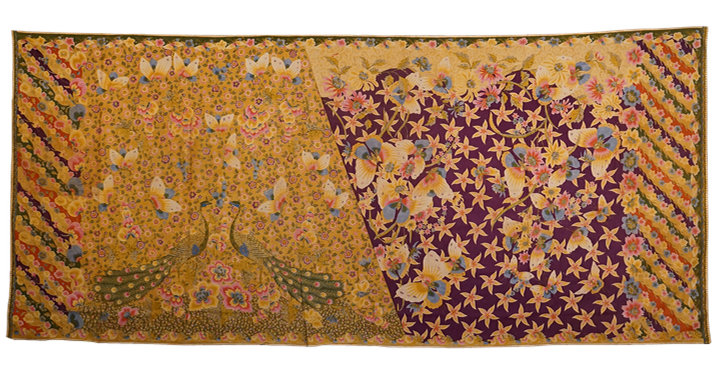
Batik Hokokai long cloth
Caption:
Hokokai batik emerged in Java during the Japanese occupation of Indonesia (1942–1945) and reflects the synthesis of Javanese batik traditions and Japanese aesthetics. Its name derives from Java Hokokai, an organization established by the Japanese administration during the occupation.
Hokokai textiles are distinguished by their finely detailed designs and elaborate motifs, which include flowers, butterflies and peacocks. The peacock is commonly associated with beauty and elegance, while the butterfly symbolizes love and harmony.
The cloth features the distinctive pagi sore (morning–evening) design, which combines two contrasting compositions on a single textile. Developed during a period of material shortages, this ingenious format allowed the cloth to be worn in two different ways, allowing a single textile to serve as multiple garments. The susomoyo border motif, adapted from the decorative hems of Japanese furisode and tomesode kimonos, illustrates how Javanese artisans incorporated and interpreted new artistic influences within the batik tradition.