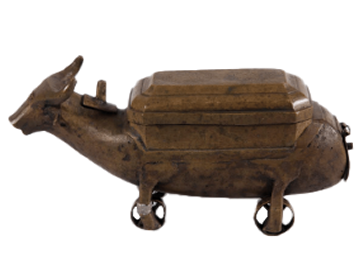
Calapa with buffalo shape
Caption:
This copper calapa (betel-nut container) is in the form of a buffalo. Calapa were traditionally used by Bruneians to store betel nuts, and later to store jewellery. Today, such calapa are mainly used as decorative items and are preserved in museums as part of Brunei's cultural heritage.
The buffalo (Bubalus bubalis) was one of the most important animals in the agricultural landscape of inland Brunei, particularly among paddy-farming communities. Farmers relied on buffaloes to clear fields for cultivation and transport heavy loads, including by pulling small boats known as kuntul.
As the animal that enabled wet-rice agriculture, the buffalo came to represent strength, endurance and the productive abundance generated through human and animal cooperation. Shaping a vessel for betel nut in the form of a buffalo brought these associations into the realm of hospitality and social prestige.
Across the Malay world, betel was offered during important encounters as a gesture of respect, welcome and relationship building, and the containers used to hold its ingredients could themselves become objects of display. By representing on a finely crafted copper vessel the animal that sustained the agricultural community, this calapa linked material prosperity with the forces that produced it: the strength of the buffalo, the fertility of the land and the abundance that supported social life.
This familiar working animal became a symbol of prosperity and continuity, and this calapa shows how Southeast Asian communities elevated the creatures that sustained their livelihoods into an auspicious symbol placed on objects of cultural value and prestige.