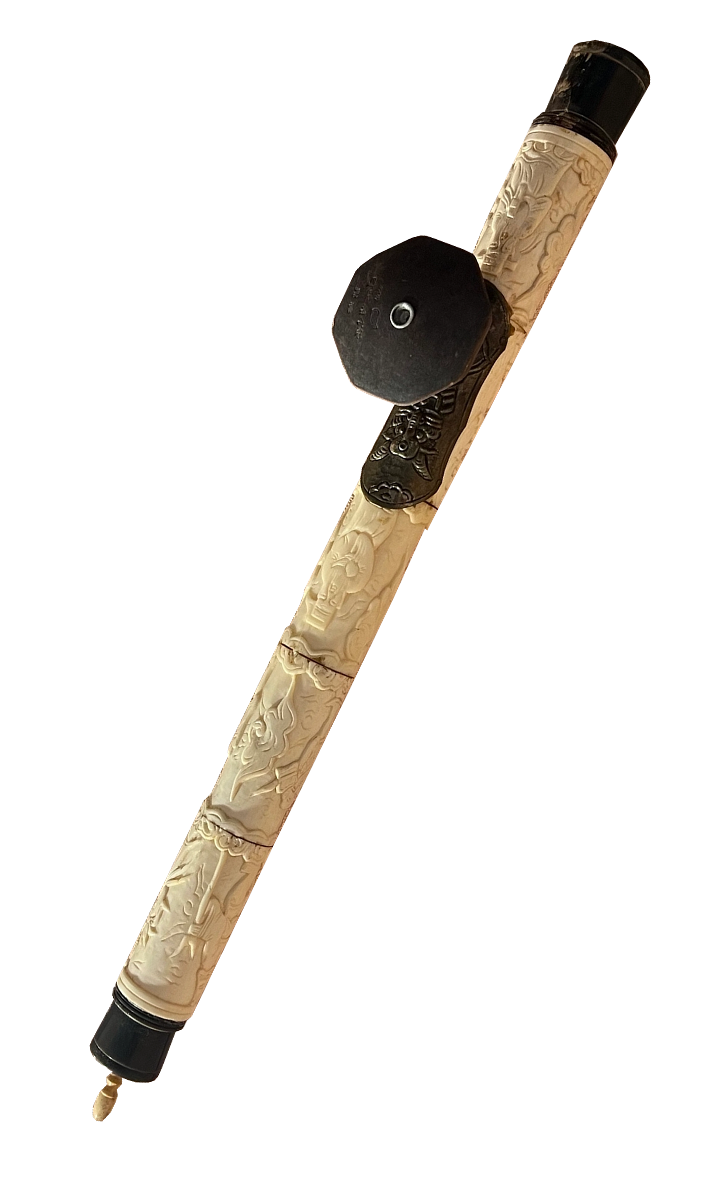
Hand-carved opium pipe
Caption:
The main stem of this hand-carved opium pipe from southern Thailand was constructed from carefully joined segments of dense bone or ivory, reinforced with blackened metal alloy fittings. Its surface is carved in low relief with Taoist immortals and deities dressed in ceremonial robes, surrounded by auspicious clouds symbolising the celestial realm and spiritual transcendence.
This pipe reveals how animal-derived materials carried meanings beyond their physical properties. Ivory was historically a highly valued material across South-East Asia, prized not only for its durability and smooth surface but also for its associations. The use of this material for an opium pipe connected the owner to wider cultural traditions in which elephants represented authority and auspiciousness. The pipe’s materials and intricate artisanship also made it an object associated with social status.
The pipe’s long stem, measuring 50.5 centimetres, was designed for smoking the pipe while reclining. Its length is both functional and technical, allowing the smoke to cool before reaching the smoker, demonstrating deep understanding of material properties and smoking practices developed in the region over generations.
This opium pipe reflects the intersection of cultural exchange and maritime trade in the southern Thai peninsula. As coastal commerce expanded during the nineteenth and twentieth centuries, Chinese communities brought their smoking customs to South-East Asia, and opium smoking became a widespread practice across the region. Under the Siamese state’s tax farming system and opium monopolies, finely crafted pipes made from valuable materials were owned by wealthy merchants, tin mine owners and community leaders and became markers of wealth and refinement.
At the same time, however, opium smoking occupied an ambivalent position within society. While opium dens served as spaces for leisure, interactions and business exchange, they were also criticized for their social and health consequences. Opium use was subsequently suppressed and much of the smoking equipment destroyed, with the result that surviving pipes such as this one became rare records of the opium trade.
Over the past century, South-East Asia’s elephant populations have declined significantly owing to hunting and illegal trade. Despite the international ban on the trade of Asian ivory under the Convention on International Trade in Endangered Species of Wild Fauna and Flora (CITES) in 1975, illegal trade remains a serious threat to elephant populations. Habitat loss and droughts compounded by climate change are also impacting these populations severely. In 1986 the International Union for Conservation of Nature (IUCN) classified the Asian elephant as Endangered on the IUCN Red List of Threatened Species.