Krutor trut
Caption:
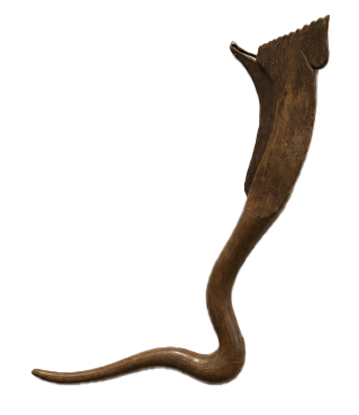
A trut (known also as a krut) – the eel-tail finger sickle – is a rice-harvesting implement for single-stalk harvesting that is unique to the agricultural landscape of southern Thailand. It features a small, curved carbon-steel blade mounted on an elongated wooden handle. The handle apex is carved to resemble a rooster's comb (hngon kai), while the sweeping rear tail mimics the form of a freshwater eel, giving the tool a distinctive dual zoomorphic identity. Its form is in stark contrast to the hand-sickles used to cut large bundles.
The design of the trut lends itself to the rice harvesting approach used in southern Thailand, where local rice varieties typically ripen at uneven rates across the same field. To use the tool, the harvester slides the elongated tail behind a cluster of mature rice stalks, then rotates their wrist to bring them against the blade and shear them cleanly – a motion that prevents grains from spilling into the mud and allows selective harvesting of only fully ripened stalks, leaving younger ones to mature.
Within the spiritual framework of southern Thai farming communities, this tool carries a sacred dimension. The trut is intimately linked to Phra Mae Phosop, the Rice Mother – the goddess of grain who is believed to reside as a living spirit within each stalk and is revered across mainland Southeast Asia. Oral traditions describe using the trut not as cutting but as formally inviting (anchoen) the Rice Mother from the paddies into the protection of the family granary – an act of welcome rather than severance.
The two animals on the handle were chosen to carry that intention. The rooster, a folkloric symbol of early rising, tireless diligence, fertility and the awakening of new life at dawn, greets the Rice Mother at the moment of harvest. The eel, deeply tied to paddy field moisture and endurance through drought, embodies the patience that makes the harvest possible. This tool, featuring both the rooster's comb and the eel's tail, is the vehicle through which a community's cosmological understanding of the harvest is transferred via the hand that holds it.
The trut embodies a shared Southeast Asian understanding of agriculture as a relationship between humans, nature and the spirit world. While the use of the rooster and eel in this tool relates to the specific plants and beliefs of southern Thailand, they also reflect a broader regional tradition in which animals carry cosmological meanings and mediate interactions between the earthly and sacred realms.