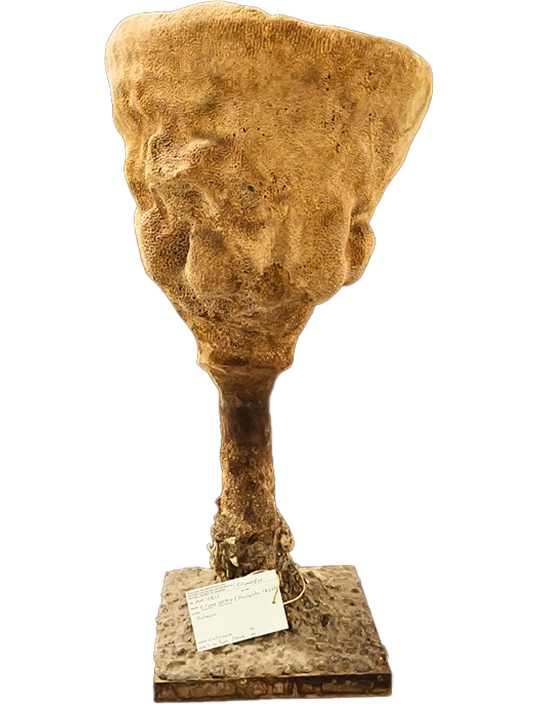
Neptune cup sponge
Caption:
The Neptune cup sponge (Cliona patera) is shaped like a cup or goblet and grows to over a metre in both height and diameter – a scale, by some accounts, large enough for a small child to sit inside its basin. This extraordinary species was described by the naturalist Thomas Hardwicke in 1820, thus making it the first animal species formally described from the island of Singapore. From the time of its first discovery, its unusual shape and immense size captured scientific and public attention.
It lives in marine soft sediment habitats across the Indo-West Pacific, with populations recorded in Singapore, Thailand and the islands of Koh Rong Sanloem and Koh Koun in Cambodia. This specimen in the Lee Kong Chian Natural History Museum was collected over a hundred years ago at a time when this species was still a familiar presence in regional waters. Its elegant goblet-like form and unusual size made it a coveted museum specimen, but also fuelled over-collection and its rapid decline.
Once abundant, it had disappeared by the early 1900s. In 2011, two living Neptune cup sponges were discovered in the Singapore Straits. Since then, populations have been found in various other parts of Southeast Asia. In a region where coastal environments are under sustained pressure, the reappearance of the Neptune cup sponge is a reminder that ending the harvesting of threatened marine species can allow them the opportunity to regenerate.