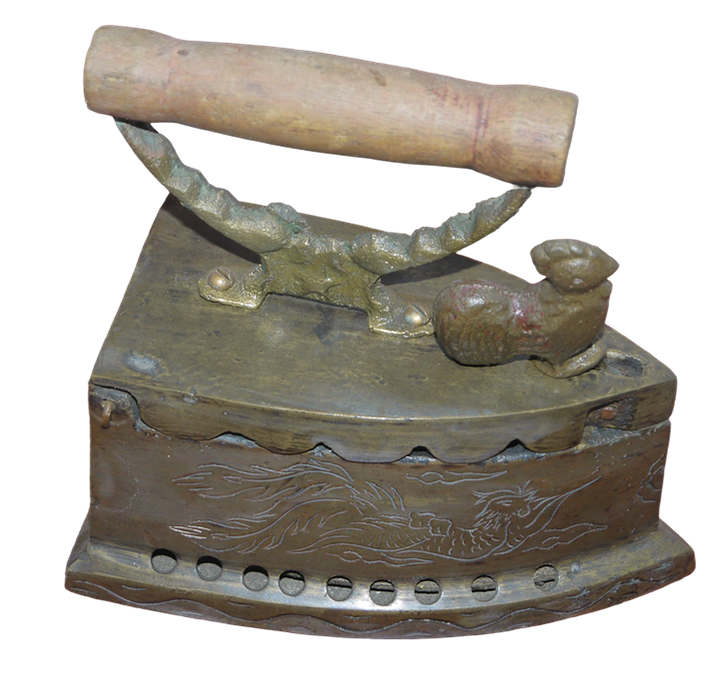
Rooster-headed brass charcoal iron
Caption:
This rooster-headed brass charcoal iron was cast from thick, high-density brass alloy. Resembling a pointed hull or a sailing galleon, it was engineered to provide substantial weight, allowing the user to smooth heavy fabric with minimal physical exertion. The hollow interior houses a chamber for charcoal, with an internal baffle plate distributing thermal energy uniformly.
The defining mechanical feature of this iron is the sculpted rooster head (hua kai) at the front apex. This component securely locks the hinged lid during use, preventing red-hot embers or fine ash from spilling out and scorching the textile. This unique feature gave rise to its colloquial name, the rooster-headed iron (tao rit hua kai). Along the lateral walls, air vents allow oxygen to circulate and keep the embers burning evenly. Larger models featuring nine vents are known locally as nine-hole irons (tao rit kao ru).
Operating the iron requires filling the core with burning charcoal and fanning it to draw air through the vents, then rubbing the hot brass soleplate over a fresh green banana leaf to release natural wax from the heated leaf. The latter process creates a smooth, non-stick surface that protects delicate fabrics while leaving a faint fragrance on the cloth.
The rooster form on the iron reflects the cultural beliefs of Chinese communities that settled in trading hubs along the Malay Peninsula, in Nakhon Si Thammarat, Songkhla and Phuket. Within Chinese cosmology, the rooster represents the virtues of early rising, tireless diligence and spiritual alertness. The iron's exterior is engraved with low-relief depictions of the dragon (mangkon) and phoenix (hong). The combination of these creatures on a domestic iron is an auspicious pairing: the dragon representing supreme authority and the masculine forces of heaven, while the phoenix represents virtue, grace and feminine power. Together they signify marital harmony and domestic abundance, qualities fitting for an object used to press clothing for weddings, festivals and ceremonies. Objects such as this iron were either imported from southern China or produced locally by Chinese-diaspora metalsmiths. This iron is a demonstration of how communities across maritime Southeast Asia adopted imported technologies and the cultural meanings associated with them.