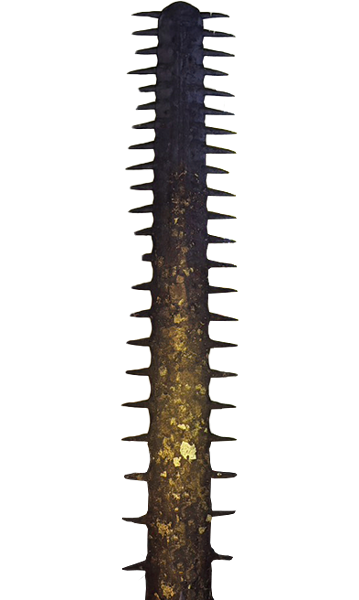
Rostrum of the largetooth sawfish
Caption:
The largetooth sawfish (Pristis pristis) is a relative of rays and is distinguished by its elongated, flattened snout known as a rostrum, which is lined with bilateral transverse teeth, resembling a double-sided saw. Sawfish possess the physiological capacity to transition between marine, brackish and freshwater environments, allowing them to inhabit both estuaries and rivers.
Historically, sawfish were prevalent across tropical Indo-Pacific waters, including Thailand, Viet Nam, Malaysia, Indonesia and the Philippines. In Southeast Asian folk belief, the formidable appearance of the sawfish gave it the status of a guardian spirit.
This association with protection led to the rostrum of the largetooth sawfish being used as a protective charm. In the Kinabatangan River basin of Sabah, Malaysia, the rostrum is nailed above doorways as a talisman to ward off evil. When wrapped in cloth and hung over a cradle, it is believed to pacify restless infants.
Elsewhere in the region, the animal’s totemic status has given the species some protection. In Dondai village at Lake Sentani in Papua, Indonesia, it is taboo to consume the flesh of the sawfish. Traditional architecture features house posts carved with sawfish motifs to commemorate maritime ancestors, and the animal also appears in bark paintings as a visual record of natural and spiritual heritage. Today, the cultural significance of the sawfish as a guardian spirit and talisman endures as part of the region’s shared beliefs and practices.
The sawfish population in Southeast Asia faces numerous threats, and the species has declined dramatically in recent decades. A unique issue experienced by this species is that its physical shape makes it highly vulnerable to entanglement in fishing nets. In addition, despite its revered status, it is harvested for its meat, for its skin, which is processed into leather, and for its rostrum, which is used in traditional medicine. Since 2006, sawfish in Southeast Asian waters have been classified as Critically Endangered on the International Union for the Conservation of Nature (IUCN) Red List.