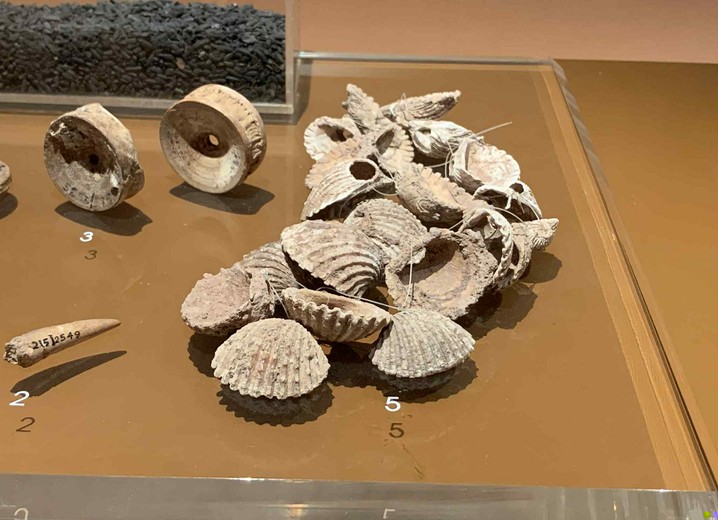
Shell beads and blood cockle shells
Caption:
Shells have held significance in Southeast Asia from prehistoric times. They have served as resources and tools, and certain types are used to make ornaments and containers. The use of shells as ornaments reflects an understanding of them as something more than raw material: shells, through their association with the sea, are symbols of life, fertility and the abundance of nature.
In the late twentieth century, shell beads dating to the prehistoric period were discovered at the Khok Phanom Di archaeological site in Chonburi Province, Thailand. The presence of shell ornaments in great quantities indicates that there was trade contact between coastal and inland communities and suggests that the shells functioned as markers of exchange and connection across distances. In the beads from Khok Phanom Di a long relationship is preserved – the sea's materials are used in the cultural life of the region, carried on the body, and are part of a long history of shared meaning.
The blood cockle (Anadara granosa) is found from the eastern coast of South Africa northward and eastward through Southeast Asia, Australia, Polynesia and up to northern Japan. Today, the blood cockle remains in use in Thailand. Its meat is consumed, while its shells are used as ornaments and are processed for lime production.