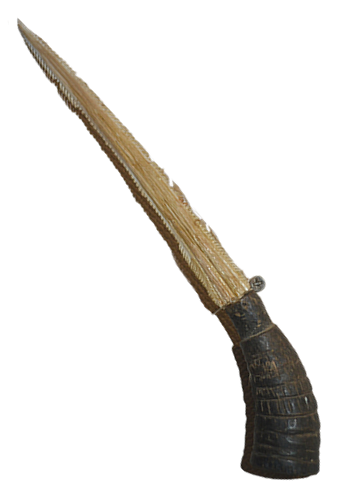
Stingray barb dagger
Caption:
Mounted on a handle fashioned from animal horn, hand-polished to ensure a secure, ergonomic grip, the blade of this dagger is made from the caudal spine of a stingray, the serrated defensive barb, known in Thai as the ngiang. Deliberately minimalist yet structurally robust, the dagger reflects how southern Thai folk artisans created items that were both useful and durable.
Seafarers, fishermen and maritime nomads (chao lay) carried such compact daggers as weapons for self-defence on long-distance maritime voyages. Naturally rigid, exceptionally sharp and flanked by retroverted, saw-like serrations, the barb blade functions as a devastating weapon. Its overall architecture allows it to pierce soft tissue effortlessly upon thrusting, while its backward-facing barbs cause extensive, jagged lacerations upon extraction.
While classical treatises on military strategy (Tamra Pichai Songkhram) focused on standard iron and steel weaponry, regional folk traditions recognized the importance of weapons crafted from raw organic matter such as bone, antler and horn.
The use of the stingray barb to form a dagger stems from the perceptions of stingrays by seafaring and fishing communities. Due to the highly painful venom delivered by live stingray barbs, folk belief attributed an inherent spiritual potency to the barb itself. Consequently, it was carried as an active talisman, believed to be capable of neutralizing hazards and warding off malevolent spirits. According to regional esoteric lore, because the barb formed a blade without being melted, smelted or altered by human fire, it retained a state of primordial purity, which elevated it from a tactical weapon into a spiritual amulet.
This dagger’s discovery in Pattani, a historical maritime trading hub on the eastern coast of the Malay Peninsula, places it within a trade-port culture. Complex commercial environments such as this, where piracy and trade disputes were common, required that coastal communities arm and protect themselves. The fact that communities across the Malay Peninsula drew on the same animal for the same purpose reflects a shared martial and spiritual vocabulary, rooted in the creatures of the water with which they shared enduring connections.