The red barking deer
Caption:
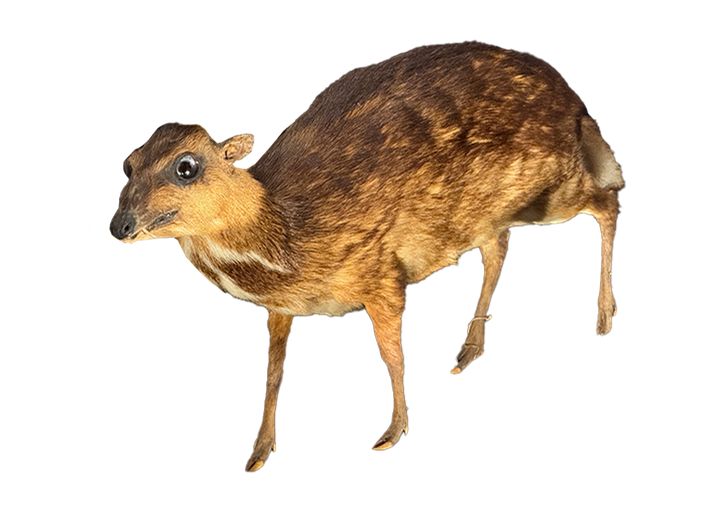
The red barking deer (Muntiacus muntjak), also known as the southern red muntjac, is among the smallest deer species in the world, with the adults weighing between 13 kilograms and 35 kilograms. This specimen is a juvenile. Adult male red barking deer have antlers and tusks, while adult females have small bony knobs on their heads, covered with tufts of fur.
Red barking deer can be found in low-density forest habitats and in forest environments near plantations in the Malay Peninsula, Sumatra, Java, Bali and Borneo. Once found in Singapore, the species is now locally extinct due to overhunting and habitat loss. Unlike most deer species, this one is omnivorous, with a diet that, while mainly consisting of vegetation and fruit, also includes bird eggs and small animals such as lizards and rodents.
In Malay, the red barking deer is known as kijang. There are several stories and symbolic meanings associated with the kijang: in Bornean Iban mythology, Telanjing Kijang is known to be a powerful female spirit; and in the Malaysian state of Kelantan, the kijang served as the royal symbol of Che Siti Wan Kembang, a warrior queen who ruled between 1610 and 1667.
The kijang is also associated with names of islands, such as Pulau Sekijang Bendera (Saint John's Island) and Pulau Sekijang Pelapah (Lazarus Island) in Singapore. According to a former headman of the islands, two barking deer lived on Sekijang Bendera. Eventually they separated, with one staying on the island and the other moving to Sekijang Pelapah, thus giving these two islands their names.