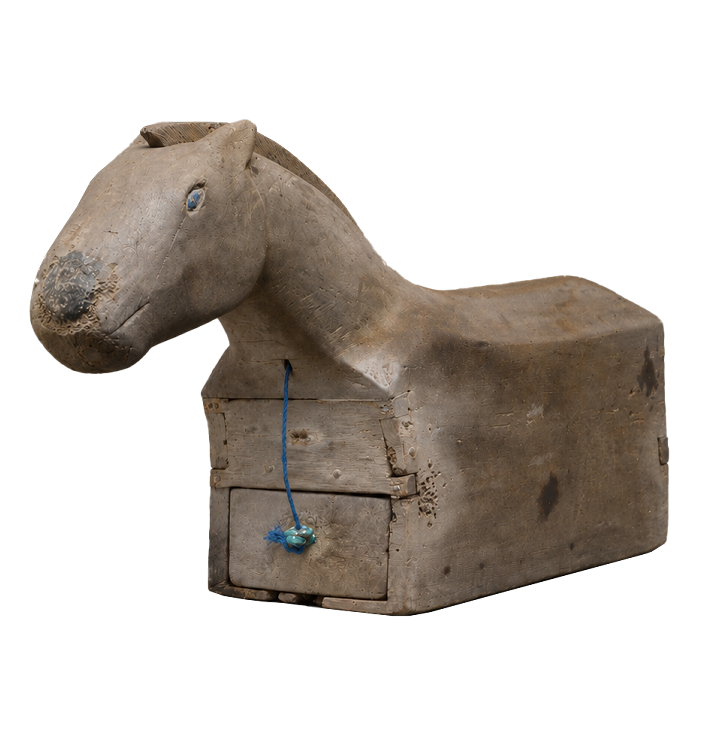
Traditional maritime boxes in horse design
Caption:
This is a wooden storage chest (ko-ta) that was used by communities from along the southern Thai coast for safeguarding vital provisions during voyages and as a charm to ensure stable sailing and good fortune. Strict taboos governed the ko-ta onboard. Under no circumstances could it be stored upside down; it had to be placed completely upright with its lid facing the heavens.
Such chests were made with high-density, resinous hardwoods such as Kiam (Cotylelobium lanceolatum) and Lumpho (Intsia palembanica), selected for their natural resistance to rot, humidity and brine. The low-set elongated rectangular shape was engineered for equilibrium on the deck of a rolling vessel, minimizing sliding or inversion during heavy swells. Lids were structured to ensure a hermetic friction fit, and many specimens featured tongue-and-groove slide locks or rattan tie-down cords. This design kept the contents of the box, such as tobacco, nipa palm wrapper leaves, fire-striking apparatus, currency and family documents, dry across multi-day expeditions.
What elevates this ko-ta into a work of folk art is its zoomorphic carving in the form of a horse, which symbolizes endurance, bravery and safe passage. Fisherfolk, despite spending much of their lives on water rather than on land, chose the horse as a spiritual companion, as it represented the courage needed to survive long voyages and could allow a vessel to gallop across cresting ocean waves. Here animal symbolism, practical engineering and the logic of survival at sea were inseparable.
The Malay-Thai linguistic root of the box’s name and the object’s presence across southern Thai coastal communities, whose lives were shaped by trade networks, reflect the shared material culture across maritime Southeast Asia.