Wooden Cold-Press Cake Molds with Elephant, Horse, and Fowl Motifs
Caption:
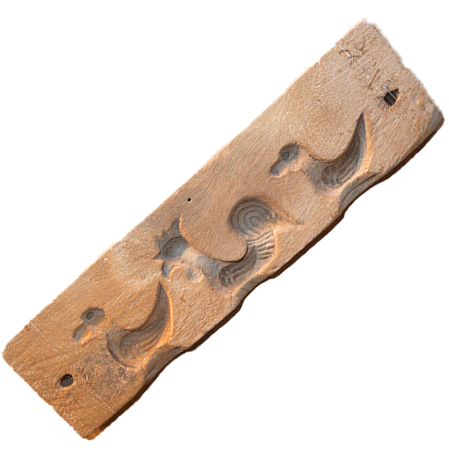
These are wooden moulds in the forms of elephants, horses and poultry. Such moulds were carved from durable local hardwoods such as jackfruit or velvet tamarind wood, with detailed recessed designs.
They are used to make traditional pastries The method involves shaping the dough entirely inside the wooden matrix without baking or heat. The pastry is then extracted with a sharp tap against a wooden table. Across Chinese, Malay-Javanese and southern Thai communities, traditional pastries made this way are served at key milestones and rites of passage, including births, cradle ceremonies, engagements, weddings and circumcision rituals, and are given as offerings in religious rituals. During Songkran (Thai New Year), younger family members arrange these pastries on fine betel nut trays or in lacquerware and offer them to their elders, receiving blessings in return. On the Sathing Phra Peninsula, this type of pastry holds a profound allegorical connection to matrimony: its name sounds identical to the Thai word meaning ‘to hold fast’ or ‘to intertwine’, making the pastry an edible prayer for marital fidelity.
Carving motifs of auspicious animals into the moulds embedded blessings directly into the pastries. The elephant (chang) denotes authority, spiritual merit and prosperity, so pastries stamped with this form are reserved for grand auspicious celebrations or are offered to high-ranking Buddhist monks and Muslim leaders. The horse (ma) represents rapid progress and career advancement, so pastries with this form are served at housewarmings or are gifted to young adults. The chicken (kai), which awakens at dawn to forage, signifies industriousness, material abundance and financial luck, so pastries with this form are served more widely.
This type of traditional mould demonstrates the trans-regional transfer of technology and beliefs. Diasporic Hokkien and Baba-Peranakan communities introduced the Chinese technology of hand-carved wooden blocks for such pastries to South-East Asia but substituted Chinese mythological creatures with animals familiar to local agrarian life and folk belief: the elephant, the horse and the chicken. Meanwhile, Malay-Javanese and Islamic traditions contributed to adapting the pastry’s recipe.
Such moulds, encompassing Chinese technological knowledge, Malay culinary tradition and the symbolic vocabularies of the elephant, the horse and the chicken, speak to a layered process of exchange, sharing and adaptation that shaped cultural life in the southern Thai-Malay Peninsula over centuries.